
Commercial Flooring Estimating Glossary
This glossary defines the terms commercial flooring estimators use every day, from net and gross quantities to attic stock, flash cove, quarter-turn installation, pattern repeat and keycodes. Each definition is short and written in plain language, with links to the detailed guides where a term affects how you measure or price a flooring bid.
- Attic stock
- Extra, uninstalled material left with the owner for repairs.
- Ashlar
- Tile or plank layout with each row offset by a fraction of a piece.
- Broadloom
- Carpet made in wide rolls, commonly 12 feet.
- Cap strip
- Trim along the top edge of flash or integral cove.
- Carpet tile
- Modular carpet squares or planks, often 24" x 24".
- Cove base
- Wall base with a toe that curves out onto the floor, used with resilient floors.
- Drop
- A length of carpet cut from a roll; also the leftover piece after a cut.
- ESD flooring
- Conductive or static-dissipative flooring that controls static electricity.
- Finish legend
- The list defining each finish code's product, size and color.
- Finish schedule
- A table listing each room's floor, base, wall and ceiling finishes.
- Flash cove / integral cove
- Sheet flooring turned up the wall to form a seamless base.
- Gross quantity
- Material to order: net area plus waste from cuts, seams and patterns.
- Heat welding
- Sealing sheet vinyl seams with melted weld rod.
- Herringbone
- Pattern of planks set at right angles in a zigzag.
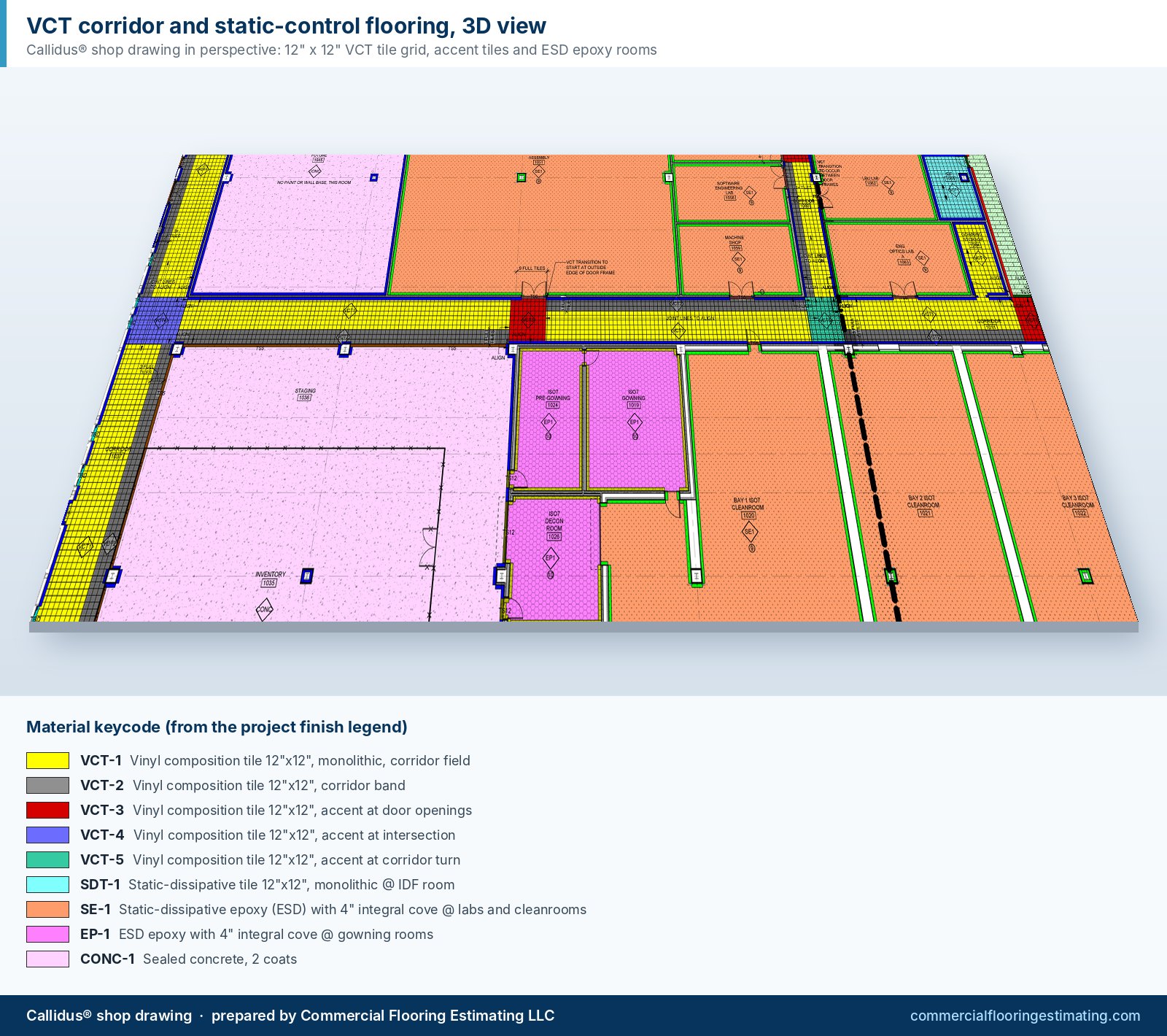
- Keycode
- Color-coded plan with a legend showing where each material goes.
- LVT / LVP
- Luxury vinyl tile / luxury vinyl plank.
- Monolithic
- Carpet tile installed with all tiles facing the same direction.
- Net quantity
- The measured area where flooring is installed.
- Pattern repeat
- The distance before a carpet's pattern repeats, in length and width.
- Pile direction
- The direction carpet fibers lean; all pieces must run the same way.
- Quarter-turn
- Carpet tile installed with each tile rotated 90° from its neighbors.
- Reducer
- A transition that slopes from a thicker floor to a lower surface.
- Resinous flooring
- Seamless floor systems such as epoxy, urethane and methyl methacrylate.
- Seam diagram
- Drawing showing carpet or sheet seam locations and roll direction.
- Square yard (SY)
- 9 square feet; the common unit for broadloom carpet.
- SDT
- Static-dissipative tile.
- Takeoff
- The measured quantities of each material from the construction documents.
- Transition strip
- Trim that joins two floor finishes.
- VCT
- Vinyl composition tile, commonly 12" x 12".
- Waste factor
- The percentage added to net area to account for cutting and layout loss.
For how these terms work together in a bid, read how to do a commercial flooring takeoff and net vs. gross flooring quantities.
Frequently Asked Questions
What is a takeoff in flooring?
A flooring takeoff is the set of measured quantities for each flooring material taken from the construction documents, including net and gross quantities and linear items such as base.
What does SY mean in flooring?
SY means square yard, which equals 9 square feet. Broadloom carpet is commonly priced and ordered by the square yard.
What is a keycode in flooring estimating?
A keycode is a color-coded plan with a legend that shows where each flooring material is installed.
What does LF mean in flooring?
LF means linear feet. It is used for items measured by length, such as wall base, transitions, cove and weld rod.
What does SF mean in flooring?
SF means square feet. It is the unit for flooring area; one square yard (SY) equals 9 SF.
Need this takeoff done for your next bid?
Send your plans and specs. Most CFE takeoffs are completed within 24–48 business hours of receiving complete documents.

Written by
Cristian Valcu – Founder & CEO, Commercial Flooring Estimating LLC
Cristian Valcu is a U.S.-based commercial flooring estimator with over 20 years of experience estimating with Callidus software in the commercial flooring industry. He is an expert in reading and interpreting floor plans, specifications and project-related information, and in producing full takeoff reports with quality material takeoffs based on all available bid documents.
Last updated: